

Fascinating Facts About Hot Air Ballooning
Up, Up, and Away! A Look at Hot Air Balloons
Hot air balloons are one of the most magical ways to take to the skies. Invented in the 18th century, they rely on simple science: hot air rises. A burner heats the air inside the balloon, making it lighter than the cooler air outside, which lifts the balloon gently off the ground.
From peaceful sunrise rides to vibrant festivals with dozens of colourful balloons dotting the sky, Hot Air Ballooning combines adventure, serenity, and stunning views. Whether you're an aviation buff or just love breathtaking experiences, there's nothing quite like drifting through the air in a giant floating balloon.
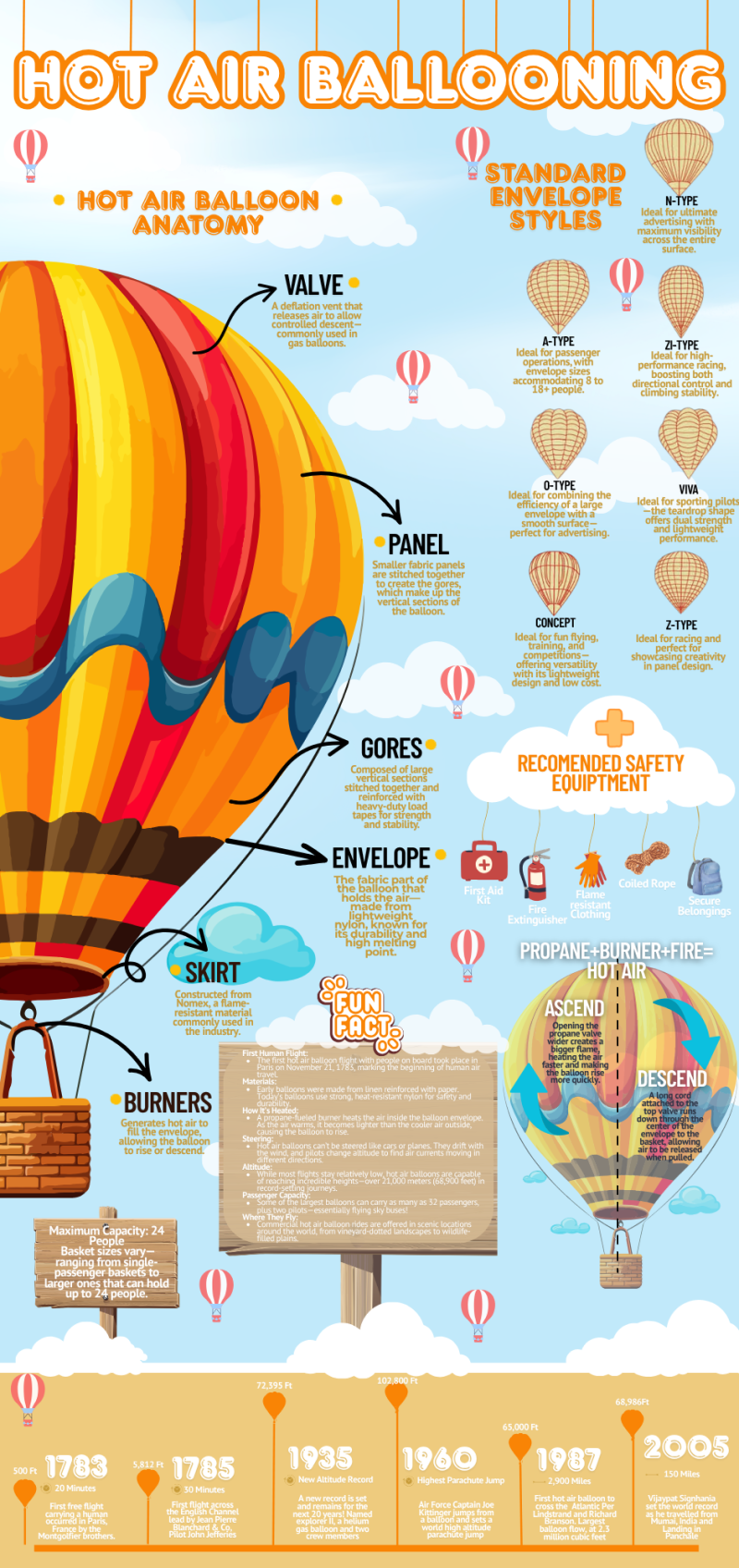
Fascinating Facts About Hot Air Balloons
First Manned Flight (1783)
- The first successful manned flight took place in Paris, France, on November 21, 1783. Piloted by Jean-François Pilâtre de Rozier and François Laurent d'Arlandes, the balloon stayed aloft for about 25 minutes and travelled over 5 miles. It was a huge leap for aviation history.
How They Fly
- Hot air balloons rise because hot air is less dense than cold air. A propane burner heats the air inside the balloon (also called the envelope), which causes the balloon to lift. To descend, the pilot simply allows the air to cool or vents hot air through the top.
No Steering Wheel, No Problem
- Pilots can’t steer in the traditional sense but use wind direction at various altitudes to guide the balloon. By ascending or descending to catch different air currents, they can navigate with surprising precision.
Speed Depends on Wind
- Balloons typically travel at 5–10 mph, but in stronger winds at higher altitudes, they can go much faster. The record for the fastest balloon flight is over 245 mph, set in a specially designed high-altitude balloon!
Sky’s the Limit
- Recreational flights usually stay below 3,000 feet for the best views and safety. However, the altitude record for a hot air balloon is 68,986 feet, achieved by Vijaypat Singhania in 205 over Mumbai, India.
Wicker Baskets: Classic for a Reason
- Baskets are traditionally made from handwoven wicker, which is light, strong, and flexible. The flexibility helps absorb impact on landing and gives passengers a smooth, safe experience.
Shapes and Colours Galore
- While the classic balloon is teardrop-shaped, many are customised into animals, characters, and logos. These “special shape” balloons are showstoppers at festivals and great for brand promotion.
Ballooning Festivals Around the World
- The Albuquerque International Balloon Fiesta in New Mexico draws over 500 balloons and hundreds of thousands of spectators each October. Other famous festivals include those in Bristol (UK), Cappadocia (Turkey), and Château-d'Oex (Switzerland).
Eco-Friendly Adventure
- Hot air balloons use clean-burning propane, and since they drift with the wind, they require no engines or fuel beyond takeoff and landing. It's one of the quietest and most peaceful ways to travel by air.
A Quiet, Magical Ride
- Once airborne, hot air ballooning is surprisingly tranquil. The only sounds are the occasional burner blast and the soft rustle of wind. With no engine noise and unobstructed views, it’s an experience often described as “floating on a cloud.”

