

How Planes Evolve: From Early Biplanes to Tomorrow’s Flying Robots
From the nimble Sopwith Camel of WWI to the iconic Spitfire and the fierce Messerschmitt Bf 109 of WWII, aircraft have come a long way. Jets like the Boeing 707 and modern marvels like the Boeing 787 and Airbus A350 showcase leaps in technology, comfort, and efficiency. Today, military drones and VTOL aircraft push boundaries even further - who knows what the future of flight holds?
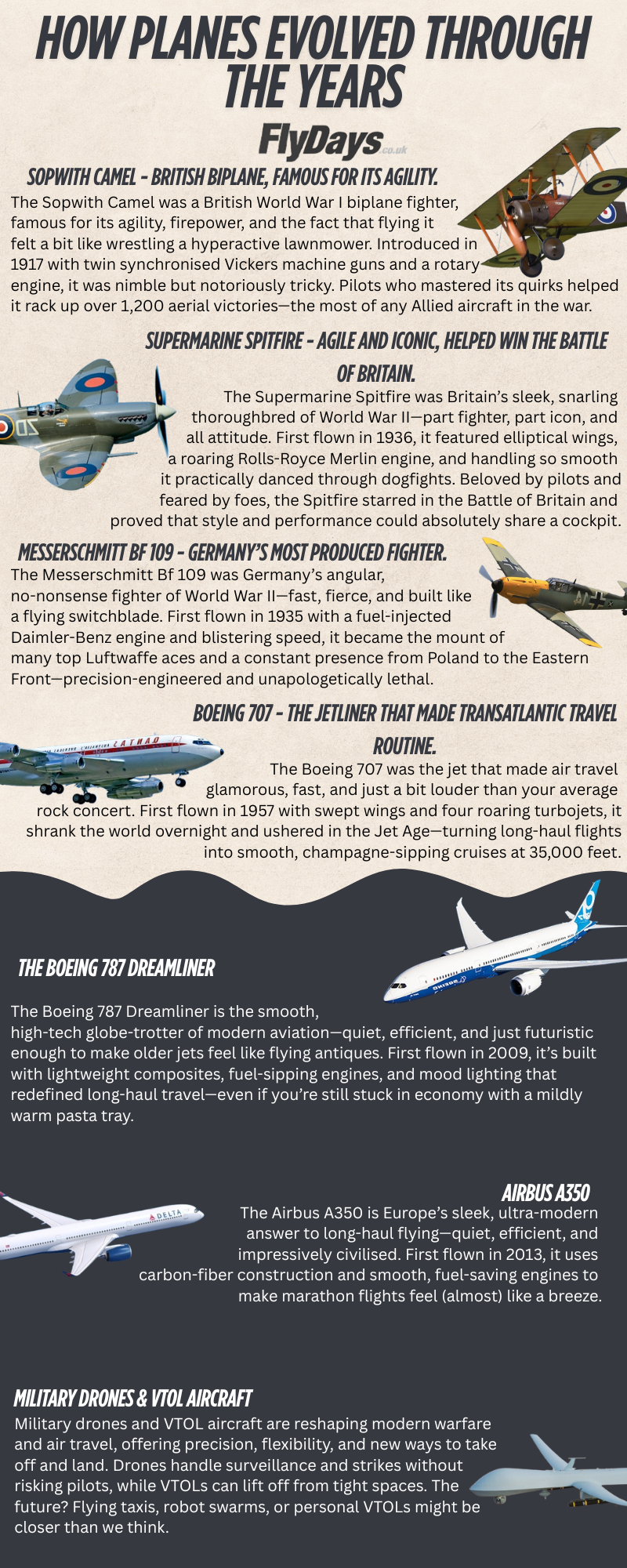
Aircraft have come a long way since the earliest days of flight, evolving through wars, technological breakthroughs, and changing needs. From daring biplanes to cutting-edge jets and futuristic drones, each generation of planes tells a story of innovation and adventure. Here’s a quick look at some of the most iconic and game-changing aircraft through history.
Sopwith Camel
The Sopwith Camel was a British World War I biplane fighter, famous for its agility, firepower, and the fact that flying it felt a bit like wrestling a hyperactive lawnmower. Introduced in 1917 with twin synchronised Vickers machine guns and a rotary engine, it was nimble but notoriously tricky. Pilots who mastered its quirks helped it rack up over 1,200 aerial victories - the most of any Allied aircraft in the war.
Supermarine Spitfire
The Supermarine Spitfire was Britain’s sleek, snarling thoroughbred of World War II - part fighter, part icon, and all attitude. First flown in 1936, it featured elliptical wings, a roaring Rolls-Royce Merlin engine, and handling so smooth it practically danced through dogfights. Beloved by pilots and feared by foes, the Spitfire starred in the Battle of Britain and proved that style and performance could absolutely share a cockpit.
Messerschmitt Bf 109
The Messerschmitt Bf 109 was Germany’s angular, no-nonsense fighter of World War II - fast, fierce, and built like a flying switchblade. First flown in 1935 with a fuel-injected Daimler-Benz engine and blistering speed, it became the mount of many top Luftwaffe aces and a constant presence from Poland to the Eastern Front - precision-engineered and unapologetically lethal.
Boeing 707
The Boeing 707 was the jet that made air travel glamorous, fast, and just a bit louder than your average rock concert. First flown in 1957 with swept wings and four roaring turbojets, it shrank the world overnight and ushered in the Jet Age - turning long-haul flights into smooth, champagne-sipping cruises at 35,000 feet.
Boeing 787 Dreamliner
The Boeing 787 Dreamliner is the smooth, high-tech globe-trotter of modern aviation - quiet, efficient, and just futuristic enough to make older jets feel like flying antiques. First flown in 2009, it’s built with lightweight composites, fuel-sipping engines, and mood lighting that redefined long-haul travel - even if you’re still stuck in economy with a mildly warm pasta tray.
Airbus A350
The Airbus A350 is Europe’s sleek, ultra-modern answer to long-haul flying - quiet, efficient, and impressively civilised. First flown in 2013, it uses carbon-fiber construction and smooth, fuel-saving engines to make marathon flights feel (almost) like a breeze.
Military drones and VTOL aircraft
Military drones and VTOL aircraft are reshaping modern warfare and air travel, offering precision, flexibility, and new ways to take off and land. Drones handle surveillance and strikes without risking pilots, while VTOLs can lift off from tight spaces. The future? Flying taxis, robot swarms, or personal VTOLs might be closer than we think.
If you’re curious to experience aviation history firsthand, why not book a Vintage Flight or even try a Flying Lesson? Whether soaring in a classic biplane like the Sopwith Camel or taking the controls of a modern plane yourself, these experiences offer a thrilling glimpse into how flying used to be - and how far we’ve come. It’s a unique way to connect with the past while feeling the freedom of the skies today.

