

Tiger Moth Vintage Plane
The de Havilland DH.82 Tiger Moth is one of the most famous training aircraft of the 20th century. First flown in 1931, it was designed by the British aircraft manufacturer de Havilland as an evolution of their earlier DH.60 Moth series. The Tiger Moth's primary role was to train military pilots, particularly during World War II, when it became the standard basic trainer for the Royal Air Force and many other Allied air forces.
With its straightforward construction, forgiving flight behaviour, and rugged design, the Tiger Moth trained tens of thousands of pilots. After the war, many surplus aircraft were sold to civilians and flying clubs, leading to long careers in civil aviation, agricultural use, and air displays. Even today, the Tiger Moth remains a favourite among vintage aircraft enthusiasts.
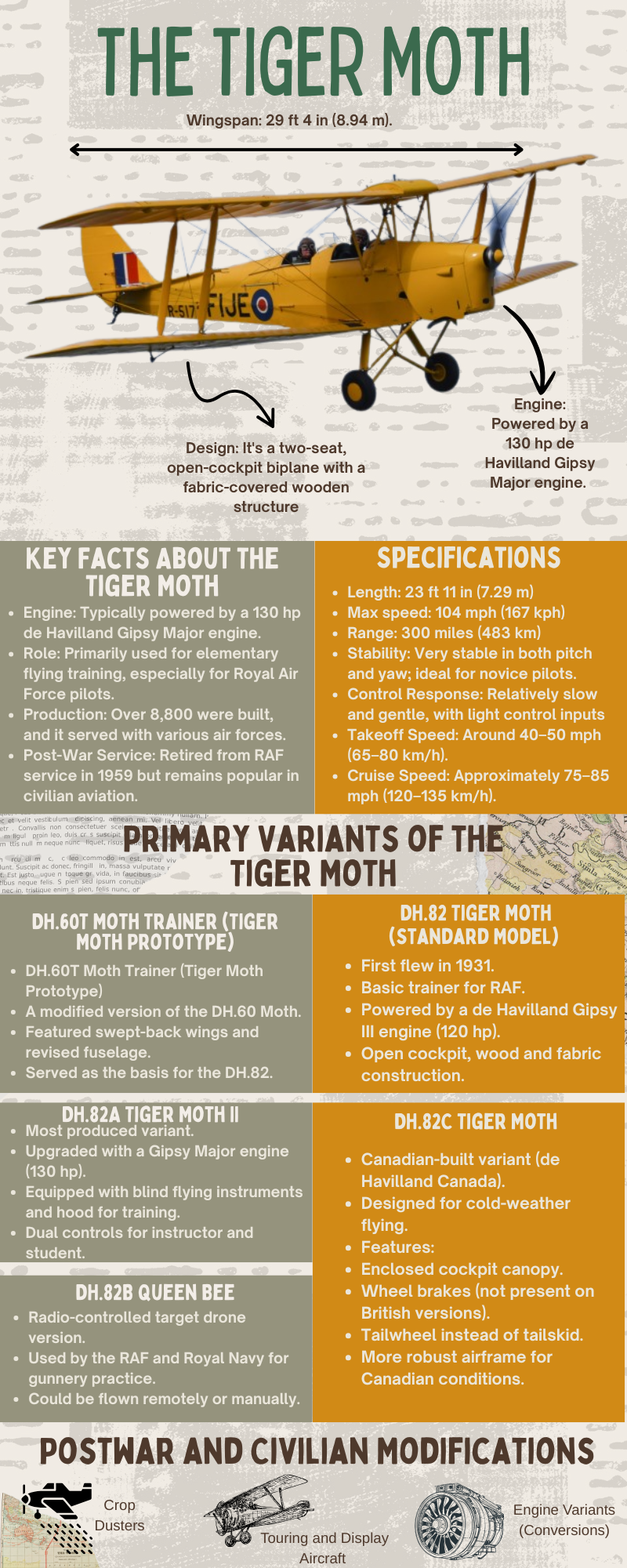
Variants of the Tiger Moth
DH.60T Moth Trainer
- Prototype version based on the DH.60 Moth.
- Featured swept-back wings and changes to improve pilot visibility.
DH.82 Tiger Moth
- First production model, powered by a Gipsy III engine (120 hp).
- Basic RAF trainer with open cockpits and fabric-covered wood construction.
DH.82A Tiger Moth II
- It's the most widely produced version.
- Upgraded with a Gipsy Major engine (130 hp).
- Equipped with blind-flying instruments and a training hood.
DH.82C Tiger Moth
- Built in Canada for cold-weather operations.
- Modifications included:
- Enclosed cockpit canopy
- Wheel brakes
- Tailwheel (instead of a tail skid)
- Reinforced airframe for rugged conditions
DH.82B Queen Bee
- A radio-controlled, pilot-optional drone version.
- Used by the RAF and Royal Navy as a target for gunnery practice.
Civilian Modifications:
Postwar, many Tiger Moths were converted for civil roles:
- Crop dusters (especially in Australia and New Zealand)
- Touring and aerobatic aircraft
- Some re-engined with Lycoming or Continental engines for reliability
Flight Characteristics
- Stable and forgiving, making it ideal for training.
- Light control forces with gentle, predictable responses.
- Lift-off speed: around 40–50 mph.
- Rate of climb: 500–700 feet per minute.
- Best climb speed: 60–65 mph.
- Cruise speed: 75–85 mph.
- Range: approximately 300 miles.
- Designed for basic aerobatics, such as loops and spins.
- The roll rate is slow, but pitch and yaw control are effective.
- G limits: typically around +4/-2 G.
- Excellent for demonstrating classic manoeuvres and teaching fundamentals.
- Stall speed: 35–40 mph.
- Approach speed: 55–60 mph.
- Landing roll: short, around 300–400 feet.
- The tailwheel requires rudder input to maintain straightness during rollout.
- Forward visibility is limited when taxiing and landing.
- Crosswind landings can be challenging without brakes or differential steering.

