

The Rise and Fall of Concorde: A Supersonic Story in Infographic Form
Take a high-speed journey through the history of Concorde with this infographic-packed feature. From its groundbreaking engineering to its luxury service - and the reasons it ultimately disappeared from the skies - we break down what made this supersonic jet an icon of aviation.
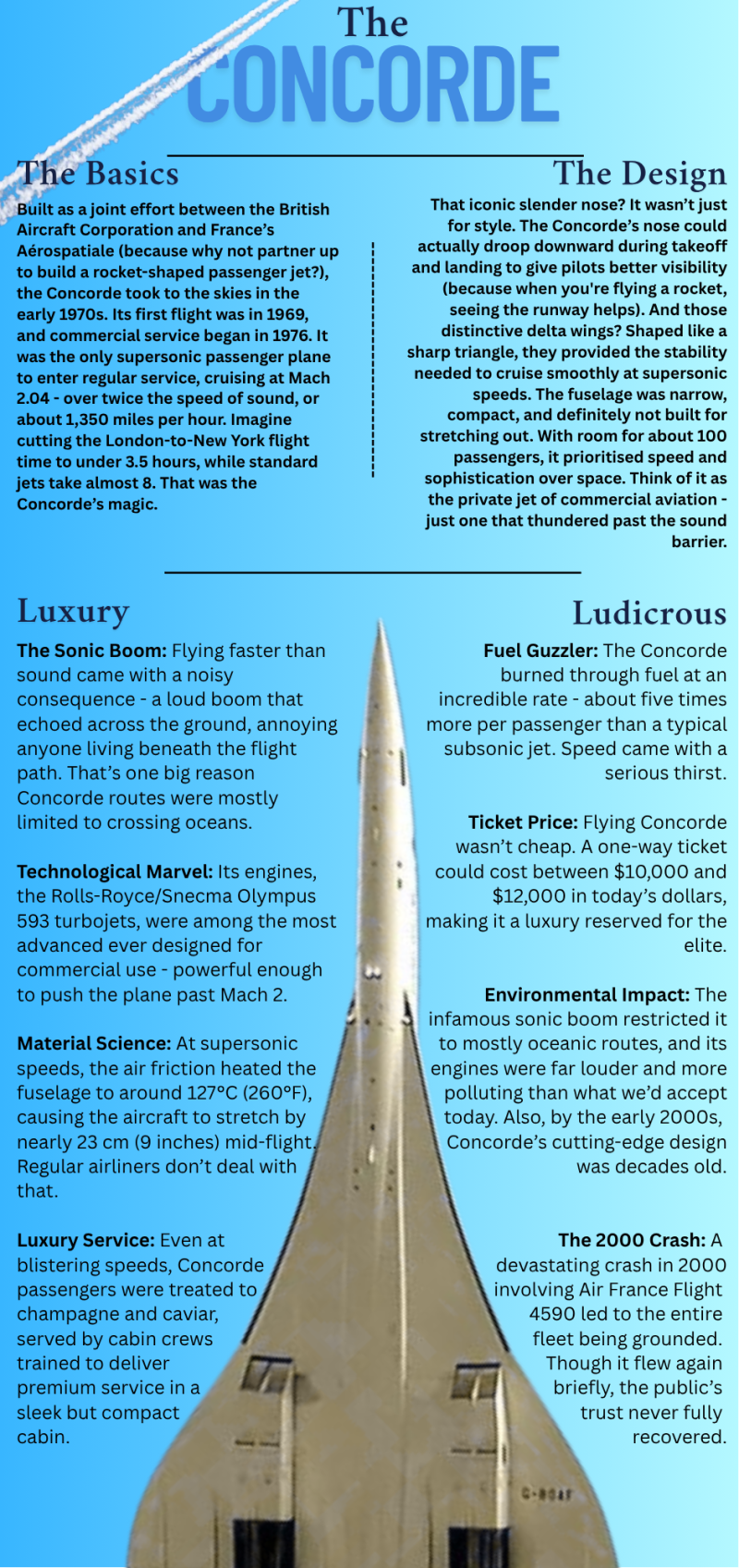
Few aircraft have captured the world’s imagination quite like the Concorde. A marvel of design, engineering, and audacity, it wasn’t just a plane - it was a statement. Sleek, fast, and impossibly futuristic, the Concorde promised a world where you could breakfast in London and still make lunch in New York. Here’s a look back at the legend that broke the sound barrier - and then some.
Built as a joint effort between the British Aircraft Corporation and France’s Aérospatiale (because why not partner up to build a rocket-shaped passenger jet?), the Concorde took to the skies in the early 1970s. Its first flight was in 1969, and commercial service began in 1976. It was the only supersonic passenger plane to enter regular service, cruising at Mach 2.04 - over twice the speed of sound, or about 1,350 miles per hour.
Imagine cutting the London-to-New York flight time to under 3.5 hours, while standard jets take almost 8. That was the Concorde’s magic.
That iconic slender nose? It wasn’t just for style. The Concorde’s nose could actually droop downward during takeoff and landing to give pilots better visibility (because when you're flying a rocket, seeing the runway helps). And those distinctive delta wings? Shaped like a sharp triangle, they provided the stability needed to cruise smoothly at supersonic speeds.
The fuselage was narrow, compact, and definitely not built for stretching out. With room for about 100 passengers, it prioritised speed and sophistication over space. Think of it as the private jet of commercial aviation - just one that thundered past the sound barrier.
Luxury
- The Sonic Boom: Flying faster than sound came with a noisy consequence - a loud boom that echoed across the ground, annoying anyone living beneath the flight path. That’s one big reason Concorde routes were mostly limited to crossing oceans.
- Technological Marvel: Its engines, the Rolls-Royce/Snecma Olympus 593 turbojets, were among the most advanced ever designed for commercial use - powerful enough to push the plane past Mach 2.
- Material Science: At supersonic speeds, the air friction heated the fuselage to around 127°C (260°F), causing the aircraft to stretch by nearly 23 cm (9 inches) mid-flight. Regular airliners don’t deal with that.
- Luxury Service: Even at blistering speeds, Concorde passengers were treated to champagne and caviar, served by cabin crews trained to deliver premium service in a sleek but compact cabin.
Ludicrous
- Fuel Guzzler: The Concorde burned through fuel at an incredible rate - about five times more per passenger than a typical subsonic jet. Speed came with a serious thirst.
- Ticket Price: Flying Concorde wasn’t cheap. A one-way ticket could cost between $10,000 and $12,000 in today’s dollars, making it a luxury reserved for the elite.
- Environmental Impact: The infamous sonic boom restricted it to mostly oceanic routes, and its engines were far louder and more polluting than what we’d accept today.
- The 2000 Crash: A devastating crash in 2000 involving Air France Flight 4590 led to the entire fleet being grounded. Though it flew again briefly, the public’s trust never fully recovered.
- Aging Tech: By the early 2000s, Concorde’s cutting-edge design was decades old. With no significant upgrades and rising costs, the numbers simply stopped making sense.
So, the Concorde flew into history - fast, iconic, and unforgettable. But if you want a taste of the future rather than the past, why not book an Electric Flying Lesson in an electric aircraft at Norwich Airport? It’s quiet, clean, and surprisingly fun to fly. Or if you want to geek out with some high-tech toys without leaving the ground, book a Drone Flying Experience or grab a session in one of our Flight Simulators - where you can experience flying a modern jet (or even a Concorde replica) from the comfort of a chair, minus the champagne but plus the ability to crash without consequences.

