

The Four Second World War Aircraft Still Flying Today
02 November 2026
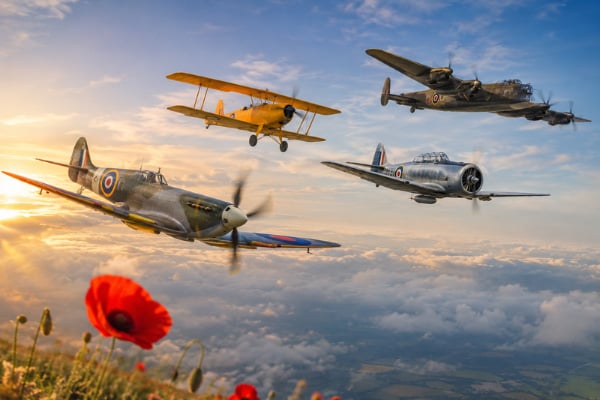
- Discover the history, design and wartime roles of four iconic Second World War aircraft, including the Spitfire, Tiger Moth and Harvard.
- Explore how vintage military training aircraft prepared generations of pilots for service during the Second World War.
- Learn why these historic aircraft remain aviation icons and how surviving examples continue to take to the skies today.
There are some aircraft that you can recognise before they've even come into view. Perhaps it's the distinctive shape of their wings, the unmistakable sound of an engine or simply the history that comes with them. Britain's wartime aviation heritage is full of machines that have become more than just aircraft. They're reminders of the people who designed, built, maintained and flew them during some of the most difficult years in modern history.
The Second World War saw enormous advances in aviation, with aircraft being developed for everything from defending Britain's skies to training the next generation of military pilots. Some became household names, while others quietly played their part behind the scenes.
What's particularly remarkable is that several of these historic machines are still airworthy today. Here are four aircraft with fascinating wartime stories and very different roles to play.
1. Supermarine Spitfire: The Defender Of Britain's Skies
Few aircraft have quite the same place in British history as the Supermarine Spitfire. With its elegant elliptical wings, streamlined fuselage and unmistakable Rolls-Royce Merlin engine, it was a remarkable piece of engineering that became a symbol of British resistance during the Second World War.
Designed by Reginald Mitchell, the Spitfire first flew in 1936 before entering RAF service in 1938. Its combination of speed, manoeuvrability and firepower made it a formidable fighter, particularly during the Battle of Britain in 1940.
Armed with eight machine guns in its early wartime configuration, the Spitfire was tasked with intercepting enemy aircraft and defending British airspace. Its agility made it particularly effective in aerial combat, often taking on German fighters such as the Messerschmitt Bf 109.
But its reputation wasn't built on engineering alone. Behind every Spitfire was a pilot, many of them remarkably young, climbing into the cockpit and taking to the skies knowing exactly what was at stake. Their courage helped make the aircraft one of the most enduring symbols of the war.
More than 20,000 Spitfires were produced across numerous variants, with the aircraft continuing to evolve throughout the conflict. Today, surviving examples remain among the most treasured sights at aviation displays and historic airfields.
You can discover more about its remarkable story through our Spitfire Flight Experiences.
2. de Havilland Tiger Moth: The Classroom In The Sky
Not every aircraft that contributed to the war effort was designed to shoot down enemy fighters. Some of the most important machines were those that taught pilots how to fly in the first place.
Enter the de Havilland Tiger Moth. First flown in 1931, this charming biplane was designed by Geoffrey de Havilland and became one of the RAF's principal primary training aircraft.
Its simple construction, tandem seating arrangement and forgiving handling made it ideal for teaching inexperienced pilots the fundamentals of flying. Before many RAF airmen could climb into the cockpit of a Spitfire or Hurricane, they had to learn the ropes in a Tiger Moth.
Its wartime duties weren't limited to training, either. Tiger Moths were also used for maritime surveillance, anti-invasion preparations and other support roles. During Operation Banquet in 1940, hundreds were even fitted with bomb racks as part of Britain's coastal defence preparations.
The aircraft's straightforward design was a large part of its success. With its two sets of stacked wings, fixed undercarriage and relatively simple controls, it was built to be practical rather than pretty. Although, there's no denying it has a certain charm.
Thousands of military pilots began their flying careers in a Tiger Moth, making it an important, if sometimes overlooked, part of Britain's wartime aviation story. It's lovely to see that surviving examples are still taking to the skies today.
3. North American Harvard: Preparing Pilots For Combat
If the Tiger Moth was the classroom, the North American Harvard was the next step towards the real thing.
Known as the T-6 Texan in the United States, the Harvard was introduced in the late 1930s and became one of the most widely used advanced training aircraft of the Second World War. It was used by British, American and Commonwealth air forces to prepare pilots for the demands of operational flying.
Unlike the relatively gentle Tiger Moth, the Harvard was a more powerful and sophisticated machine. Its radial engine, retractable landing gear and more demanding handling characteristics helped trainee pilots develop the skills needed before progressing to frontline fighters.
It was particularly important for preparing pilots for aircraft such as the Spitfire and Hurricane, giving them experience of faster, more complex machines before heading into combat.
The Harvard wasn't simply a training aircraft, however. Its design also allowed for armament, and some versions were adapted for combat and operational duties.
Over 5,000 Harvards were supplied to British and Commonwealth air forces during the war, making a substantial contribution to military pilot training. It remained in RAF service into the 1950s, a testament to just how useful and dependable the design proved to be.
Today, its distinctive shape and powerful engine make it a favourite among vintage aviation enthusiasts. Seeing one flying is a reminder of the thousands of pilots who passed through its cockpit before taking on far greater challenges.
4. Boeing-Stearman Model 75: Training The American Airmen
Across the Atlantic, another biplane was helping prepare pilots for wartime service. The Boeing-Stearman Model 75 became one of the most recognisable American military trainers of the era.
Developed during the 1930s, the Stearman was built with practicality in mind. Its sturdy construction, simple design and familiar biplane layout made it well suited to training inexperienced pilots. It was used by the United States and Royal Canadian Air Forces before and during the Second World War.
More than 10,000 were produced, providing an important training platform for the thousands of airmen preparing to serve. Like the Tiger Moth, it gave pilots their first real taste of military flying, helping them develop the confidence and control needed for more advanced aircraft.
What makes the Stearman particularly interesting is how little it needed to be complicated. It was a robust, straightforward machine designed to do its job reliably, rather than impress anyone with unnecessary technology.
Following the war, thousands of surplus Stearmans found new homes in civilian aviation. Some were used for agricultural work, others became popular aerobatic aircraft, while many were lovingly restored by vintage aviation enthusiasts.
Its legacy has also continued through wing walking, with its strong biplane construction making it particularly well suited to the unusual activity. Not quite what its original designers had in mind, perhaps, but certainly a memorable second career.
Keeping Aviation History Alive
These four aircraft had very different jobs during the Second World War. The Spitfire defended Britain's skies, while the Tiger Moth, Harvard and Boeing-Stearman helped prepare thousands of pilots for military service.
Yet they all share something important. Each represents a different part of aviation history, from the engineering achievements of the era to the dedication of the people who depended on them.
It's easy to remember the famous fighters and the headline grabbing battles, but the training aircraft deserve their place in the story, too. Without them, many of the pilots who went on to serve in frontline squadrons would never have taken their first steps towards becoming military airmen.
Surviving examples remain airworthy today, and vintage flying experiences give visitors an opportunity to see these historic aircraft beyond a museum setting. You can explore more about these remarkable machines and their stories through our range of vintage aircraft experiences.
Aircraft can be restored, engines can be started and old designs can take to the skies once again. But the people and events that made them important should never be forgotten. Keeping these machines flying is one small way of ensuring that their stories continue to be told for generations to come.

